消费端自定义监听
我们一般就是在代码中编写while循环,进行consumer.nextDelivery()方法进行获取下一条消息,然后进行
消费处理.但是我们使用自定义的Consumer更加的方便,解耦性更加的强,也是在实际工作中最常用的使用方式!
实现消费端自定义监听的两种方式
实现com.rabbitmq.client.Consumer接口
import java.io.IOException;

/**
 * Interface for application callback objects to receive notifications and messages from
 * a queue by subscription.
 * Most implementations will subclass {@link DefaultConsumer}.
 * <p/>
 * The methods of this interface are invoked in a dispatch
 * thread which is separate from the {@link Connection}'s thread. This
 * allows {@link Consumer}s to call {@link Channel} or {@link
 * Connection} methods without causing a deadlock.
 * <p/>
 * The {@link Consumer}s on a particular {@link Channel} are invoked serially on one or more
 * dispatch threads. {@link Consumer}s should avoid executing long-running code
 * because this will delay dispatch of messages to other {@link Consumer}s on the same
 * {@link Channel}.
 *
 * @see Channel#basicConsume(String, boolean, String, boolean, boolean, java.util.Map, Consumer)
 * @see Channel#basicCancel
 */
public interface Consumer {
    /**
     * Called when the consumer is registered by a call to any of the
     * {@link Channel#basicConsume} methods.
     * @param consumerTag the <i>consumer tag</i> associated with the consumer
     */
    void handleConsumeOk(String consumerTag);

    /**
     * Called when the consumer is cancelled by a call to {@link Channel#basicCancel}.
     * @param consumerTag the <i>consumer tag</i> associated with the consumer
     */
    void handleCancelOk(String consumerTag);

    /**
     * Called when the consumer is cancelled for reasons <i>other than</i> by a call to
     * {@link Channel#basicCancel}. For example, the queue has been deleted.
     * See {@link #handleCancelOk} for notification of consumer
     * cancellation due to {@link Channel#basicCancel}.
     * @param consumerTag the <i>consumer tag</i> associated with the consumer
     * @throws IOException
     */
    void handleCancel(String consumerTag) throws IOException;

    /**
     * Called when either the channel or the underlying connection has been shut down.
     * @param consumerTag the <i>consumer tag</i> associated with the consumer
     * @param sig a {@link ShutdownSignalException} indicating the reason for the shut down
     */
    void handleShutdownSignal(String consumerTag, ShutdownSignalException sig);

    /**
     * Called when a <code><b>basic.recover-ok</b></code> is received
     * in reply to a <code><b>basic.recover</b></code>. All messages
     * received before this is invoked that haven't been <i>ack</i>'ed will be
     * re-delivered. All messages received afterwards won't be.
     * @param consumerTag the <i>consumer tag</i> associated with the consumer
     */
    void handleRecoverOk(String consumerTag);

    /**
     * Called when a <code><b>basic.deliver</b></code> is received for this consumer.
     * @param consumerTag the <i>consumer tag</i> associated with the consumer
     * @param envelope packaging data for the message
     * @param properties content header data for the message
     * @param body the message body (opaque, client-specific byte array)
     * @throws IOException if the consumer encounters an I/O error while processing the message
     * @see Envelope
     */
    void handleDelivery(String consumerTag,
                        Envelope envelope,
                        AMQP.BasicProperties properties,
                        byte[] body)
        throws IOException;
}
继承com.rabbitmq.client.DefaultConsumer类
import java.io.IOException;

/**
 * Convenience class providing a default implementation of {@link Consumer}.
 * We anticipate that most Consumer implementations will subclass this class.
 */
public class DefaultConsumer implements Consumer {
    /** Channel that this consumer is associated with. */
    private final Channel _channel;
    /** Consumer tag for this consumer. */
    private volatile String _consumerTag;

    /**
     * Constructs a new instance and records its association to the passed-in channel.
     * @param channel the channel to which this consumer is attached
     */
    public DefaultConsumer(Channel channel) {
        _channel = channel;
    }

    /**
     * Stores the most recently passed-in consumerTag - semantically, there should be only one.
     * @see Consumer#handleConsumeOk
     */
    public void handleConsumeOk(String consumerTag) {
        this._consumerTag = consumerTag;
    }

    /**
     * No-op implementation of {@link Consumer#handleCancelOk}.
     * @param consumerTag the defined consumer tag (client- or server-generated)
     */
    public void handleCancelOk(String consumerTag) {
        // no work to do
    }

    /**
     * No-op implementation of {@link Consumer#handleCancel(String)}
     * @param consumerTag the defined consumer tag (client- or server-generated)
     */
    public void handleCancel(String consumerTag) throws IOException {
        // no work to do
    }

    /**
     * No-op implementation of {@link Consumer#handleShutdownSignal}.
     */
    public void handleShutdownSignal(String consumerTag, ShutdownSignalException sig) {
        // no work to do
    }

     /**
     * No-op implementation of {@link Consumer#handleRecoverOk}.
     */
    public void handleRecoverOk(String consumerTag) {
        // no work to do
    }

    /**
     * No-op implementation of {@link Consumer#handleDelivery}.
     */
    public void handleDelivery(String consumerTag,
                               Envelope envelope,
                               AMQP.BasicProperties properties,
                               byte[] body)
        throws IOException
    {
            // no work to do
    }

    /**
    *  Retrieve the channel.
     * @return the channel this consumer is attached to.
     */
    public Channel getChannel() {
        return _channel;
    }

    /**
    *  Retrieve the consumer tag.
     * @return the most recently notified consumer tag.
     */
    public String getConsumerTag() {
        return _consumerTag;
    }
}
消费端自定义监听代码演示
消费端自定义监听
import com.rabbitmq.client.*;
import java.io.IOException;

/**
 * @Classname MyConsumer
 * @Description 自定义消费端
 * @Date 2019/9/9 16:03
 * @Created by Jiavg
 */
public class MyConsumer extends DefaultConsumer {

    private Channel channel;

    /**
     * Constructs a new instance and records its association to the passed-in channel.
     * @param channel the channel to which this consumer is attached
     */
    public MyConsumer(Channel channel) {
        super(channel);
        this.channel = channel;
    }

    @Override
    public void handleDelivery(String consumerTag, Envelope envelope, AMQP.BasicProperties properties, byte[] body) throws IOException {
        // super.handleDelivery(consumerTag, envelope, properties, body);
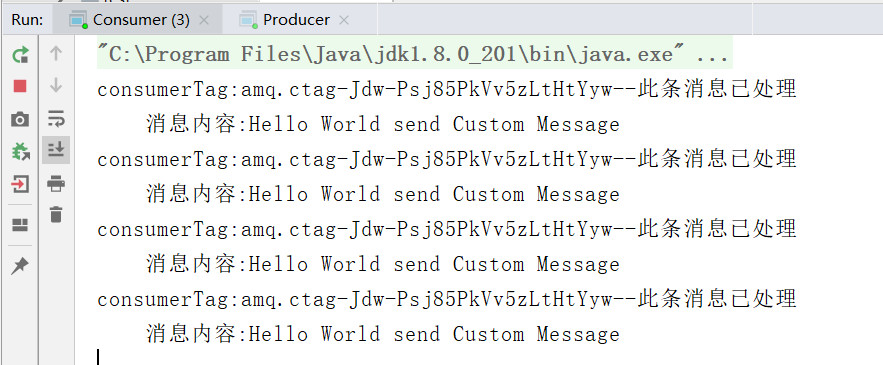
        System.out.println("consumerTag:" + consumerTag + "--此条消息已处理");
        System.out.println("\t消息内容:" + new String(body));

        channel.basicAck(envelope.getDeliveryTag(), false);
    }
}
消费端代码实现
import com.rabbitmq.client.Channel;
import com.rabbitmq.client.Connection;
import com.rabbitmq.client.ConnectionFactory;

/**
 * @Classname Consumer
 * @Description 消费端自定义监听:消费端
 * @Date 2019/9/8 10:48
 * @Created by Jiavg
 */
public class Consumer {

    public static void main(String[] args) throws Exception{

        ConnectionFactory connectionFactory = new ConnectionFactory();
        connectionFactory.setHost("127.0.0.1");
        connectionFactory.setPort(5672);
        connectionFactory.setVirtualHost("/");
        connectionFactory.setUsername("guest");
        connectionFactory.setPassword("guest");

        Connection connection = connectionFactory.newConnection();

        Channel channel = connection.createChannel();

        String exchangeName = "test_Custom_Exchange";
        String routingKey = "Custom.#";
        String queueName = "test_Custom_Queue";

        // 声明交换机、声明队列、绑定队列到交换机
        channel.exchangeDeclare(exchangeName, "topic", true, false, null);
        channel.queueDeclare(queueName, true, false, false, null);
        channel.queueBind(queueName, exchangeName, routingKey);

        MyConsumer myConsumer = new MyConsumer(channel);
        channel.basicConsume(queueName, false, myConsumer);
    }
}
生产端代码实现
import com.rabbitmq.client.Channel;
import com.rabbitmq.client.Connection;
import com.rabbitmq.client.ConnectionFactory;

/**
 * @Classname Producer
 * @Description 消费端自定义监听:生产端
 * @Date 2019/9/8 10:50
 * @Created by Jiavg
 */
public class Producer {

    public static void main(String[] args) throws Exception{

        ConnectionFactory connectionFactory = new ConnectionFactory();
        connectionFactory.setHost("127.0.0.1");
        connectionFactory.setPort(5672);
        connectionFactory.setVirtualHost("/");
        connectionFactory.setUsername("guest");
        connectionFactory.setPassword("guest");

        Connection connection = connectionFactory.newConnection();

        Channel channel = connection.createChannel();

        String exchangeName = "test_Custom_Exchange";
        String routingKey = "Custom.save";
        String msg = "Hello World send Custom Message";

        for (int i = 0; i < 4; i++){
            channel.basicPublish(exchangeName, routingKey, null, msg.getBytes());
        }
    }
}
消费端控制台变换